The Future of Scrum: What’s New in SBOK® Guide Version 5
When Agile teams struggle, it is rarely because they do not care about collaboration or delivery. More often, it is because teams are trying to move fast without a shared understanding of how Scrum is actually meant to work in practice.
That is one reason Scrum certifications continue to matter.
For professionals stepping into Scrum Master or Product Owner roles, certification creates a common language, a stronger understanding of Agile principles, and a practical framework for helping teams deliver value more effectively. And as AI tools continue to reshape how organizations work, that foundation matters more than ever.
Why Scrum Certifications Still Matter
There is a misconception that Scrum is simply “having standups” or “working in sprints.” In reality, effective Scrum requires intentional systems for prioritization, communication, accountability, and continuous improvement.
Certifications such as Scrum Master Certified (SMC®) and Scrum Product Owner Certified (SPOC®) through SCRUMstudy help professionals understand:
The roles and responsibilities within Scrum teams
How to facilitate collaboration and remove blockers
How to prioritize work based on customer value
How to improve transparency and adaptability
How to manage changing requirements without creating chaos
How to create sustainable delivery systems for teams
For organizations, certification also creates alignment. Teams begin using consistent terminology, shared workflows, and repeatable processes that reduce confusion and improve execution.
At Nimble Up, we often talk about the importance of clarity architecture and execution systems. Scrum, when implemented thoughtfully, supports both.
What Is the SBOK® Guide?
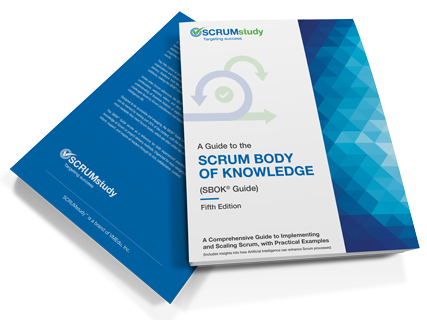
The SBOK® Guide (Scrum Body of Knowledge) is the foundational framework developed by SCRUMstudy for Scrum and Agile project management education.
It provides practical guidance around Scrum principles, processes, and best practices while helping teams understand how to apply Agile thinking in real-world environments.
Unlike approaches that focus heavily on theory alone, the SBOK® Guide is designed to bridge the gap between learning Scrum concepts and implementing them inside organizations.
This practical focus is part of why many organizations use SCRUMstudy certifications as a way to onboard leaders, project managers, product owners, and teams into Agile ways of working.
What’s New in SBOK® Guide Version 5?
The recently released SBOK® Guide Fifth Edition includes several updates designed to reflect how modern Agile teams actually operate today.
One of the most notable additions is the integration of AI-powered Scrum tools throughout the learning experience.
Updates include:
Addition of a new “AI-powered Scrum Tool” across many process inputs, tools, and outputs (ITOs)
Examples showing how AI and Scrum tools can support Scrum practitioners in real workflows
Screenshots and demonstrations using popular platforms such as:
Vabro.ai
Jira
ClickUp
Monday
Wrike
Asana
General updates to improve clarity, accuracy, tables, and figures throughout the guide
These updates may seem small on the surface, but they reflect a much larger shift happening across organizations.
Scrum + AI Requires More Clarity, Not Less
AI can absolutely accelerate work. Teams can generate documentation faster, summarize meetings instantly, automate workflows, and surface insights more quickly than ever before.
But AI does not replace leadership, decision-making, or team clarity.
In many organizations, AI actually exposes where clarity is missing.
If priorities are unclear, AI generates more noise.
If decision ownership is undefined, AI creates more options without resolution.
If workflows are inconsistent, automation simply accelerates confusion.
That is why foundational Scrum knowledge still matters.
Strong Scrum practitioners understand:
How work flows through a team
How to prioritize effectively
How to create transparency
How to adapt without losing focus
How to facilitate communication between humans, not just systems
The addition of AI-focused tools inside SBOK® Guide Version 5 reflects the reality that modern Agile teams need both:
Human-centered leadership
Technology-enabled execution
The strongest teams will know how to use AI as an enhancement to clear systems, not as a replacement for them.
Benefits of Scrum Master and Product Owner Certification
For individuals, certification can help:
Build credibility and confidence
Improve career opportunities
Strengthen leadership and facilitation skills
Increase understanding of Agile frameworks
Improve cross-functional communication
Prepare professionals to lead modern hybrid and AI-enabled teams
For organizations, certified Scrum professionals can help:
Improve delivery consistency
Reduce bottlenecks
Increase adaptability
Improve team communication
Create clearer accountability structures
Support healthier and more resilient team operations
In today’s environment, organizations need teams that can adapt quickly without losing alignment. Scrum certifications help build that capability.
At the end of the day, the updates in SBOK® Guide Version 5 will help Scrum practitioners understand how modern tools can support stronger execution.
Technology will continue evolving. Teams will continue changing. But the organizations that thrive will still be the ones that create clarity, communicate effectively, and adapt intentionally. And Scrum remains one of the most practical frameworks for helping teams do just that.