
Use Gradients of Agreement to Determine Buy-In

Clarify commitment. Build trust. Make better decisions.
If you’ve ever sat in a meeting where a decision was “approved” but somehow still unraveled later… you already know the problem.
A quick “Any objections?”
A few nods.
Silence.
“Great, we’re aligned.”
Except you weren’t.
Real buy-in rarely fits into a simple yes-or-no vote. And when we force binary decisions, we miss the nuance that actually determines whether something will succeed.
That’s where the Gradients of Agreement come in.
What Is the Gradients of Agreement Technique?
The Gradients of Agreement is a group decision-support tool described in The Facilitator's Guide to Participatory Decision-Making by Sam Kaner and colleagues. Instead of asking people to vote yes or no, it provides an eight-point scale that allows participants to express their true level of support.
Here’s the scale:
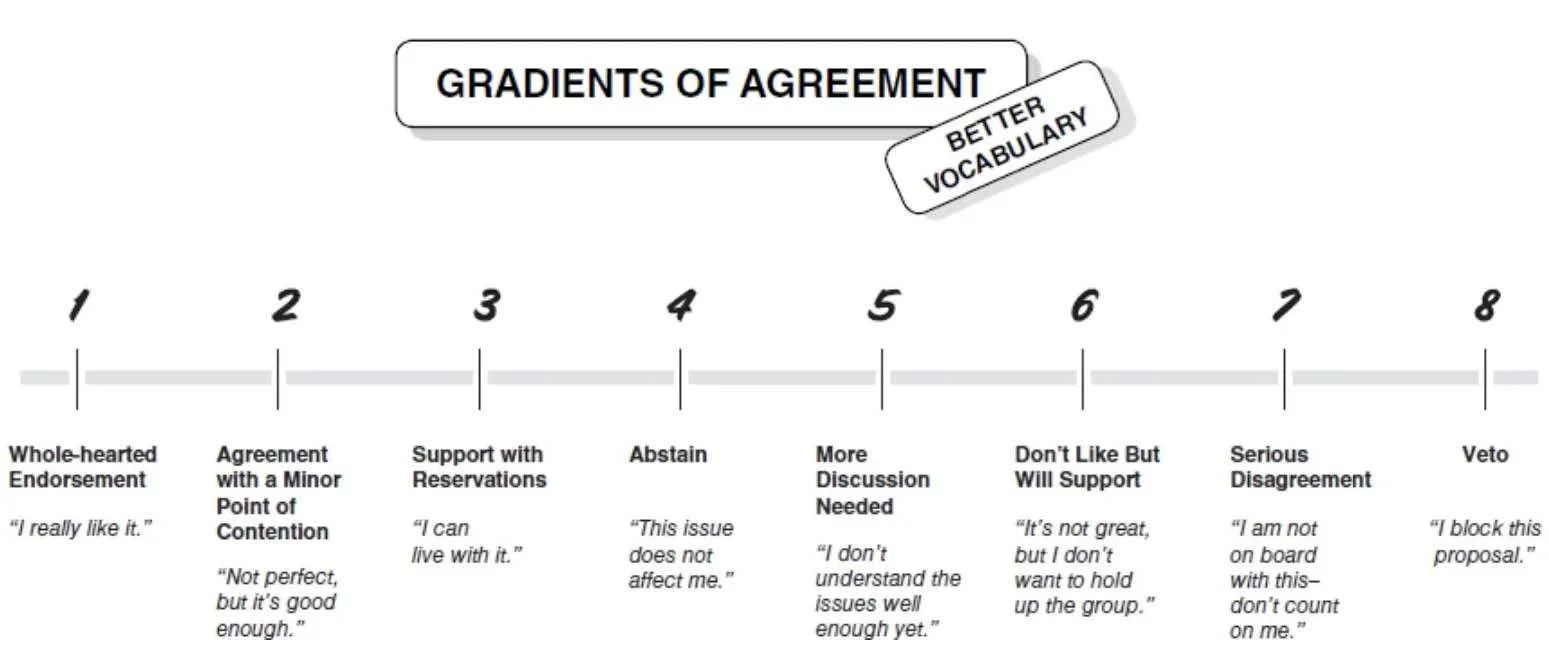
When leaders ask team members to indicate where they fall on this gradient, nuance surfaces.
Instead of hiding their hesitation behind polite silence, people can express reservations without derailing the conversation. Instead of forcing artificial consensus, the group sees the real landscape of support.
Why This Matters for Teams
I see this pattern constantly: leaders believe they have alignment, but what they really have is compliance. The difference will show up later in missed deadlines, resistance, or lack of follow-through.
Instead, Gradients of Agreement will help you:
Clarify true commitment levels
Surface misunderstandings early
Identify where additional information is needed
Distinguish between disagreement and lack of clarity
Avoid premature consensus
Not every decision requires full enthusiasm. Sometimes “I can live with it” is good enough. But knowing that’s the level of support you have allows you to plan accordingly.
How to Use It in Practice
Create a simple visual tool (think: a slide, a whiteboard drawing, or even printed cards numbered 1 through 8). After presenting a proposal, ask each participant to indicate their position on the gradient.
Pause and observe. Notice patterns.
Are most people at levels 2–3? That may be sufficient alignment.
Are several people at 5? More clarity is needed.
Is someone at 7 or 8? That deserves attention before moving forward.
When you normalize the nuance in decision-making, you strengthen psychological safety. And when people feel safe expressing their hesitation, they are far more likely to fully commit once they’ve achieved some clarity. Think of it like this…
Clarity = Commitment. Commitment = Trust. Trust = Performance.
And that is how better decisions actually get made!